After a few months top-roping at the climbing gym, many people will want to progress to lead climbing. This is a natural progression, and one your gym will be happy to facilitate. Some gyms provide dedicated lead ropes, while others will require that you bring your own climbing rope for lead climbing. You should ask the staff at your gym what their policy is. This article is a buying guide specifically for gym climbing ropes, as well as some advice on the appropriate size for a gym climbing rope.
What Length Should a Gym Climbing Rope Be?
The standard length for a gym climbing rope is 30 meters. Since the rope needs to go up to the anchors and back down to the ground, this means you can climb routes up to about 15 meters (50 feet) in length. Most climbing rope models can be bought in a 30 meter length. Some newer gyms have extra tall walls which require a 40-meter rope. These are also available commercially, but a bit less common. Check the height of the walls at your gym, and ask the staff what length of rope they recommend.
What’s the Correct Diameter for a Gym Climbing Rope?
The top-ropes at your gym are probably a diameter of around 10.5mm. These ropes are thick and beefy, designed for continuous use and a high margin of safety. The top-ropes at a gym are also static ropes, meaning they do not stretch. An ideal gym climbing lead rope is a little different: slimmer, and also dynamic, meaning it stretches to absorb some energy in falls.
For size, we prefer a gym climbing rope to be around 9.8mm, plus or minus a millimeter or two. This is a good size which can handle a lot of falls before wearing out, but not so thick that it becomes obnoxiously heavy or difficult to move through a belay device.
Below we recommend some of our favorite models of gym climbing ropes. Most of these come in both 30 and 40-meter lengths.
Sterling Slim Gym Climbing Rope 10.1
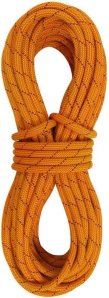
We really like Sterling ropes. Their handling is usually superb, with a silky feel in the hand. The slim gym is the biggest rope in our roundup, according to the numbers. That said, it still handles very well, and feels comparable to the other options in practice. And the extra size ensures it will last a very long time. Sterling ropes are made in the USA with a high commitment to sustainability.
Mammut 9.5 Gym Classic

This is the slimmest rope in this lineup, meaning it is the lightest (good) and least durable (bad). 9.5mm is still a pretty thick and durable rope, we just want to emphasize the tradeoff that comes with lighter weight ropes. Personally we actually like this diameter – but we yell TAAAAAKE instead of whipping. Comes in 40-meter length only.
Mammut 9.9 Gym Workhorse Classic Rope
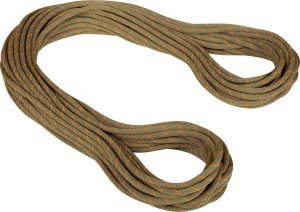
On the other hand, this Workhorse Mammut gym rope is extra-thick, compared to the standard 9.8s. This just makes it a little more durable and long-lasting, making it a great choice if you don’t want to think about replacing your climbing rope for a really long time. If you’re strapped for cash too, then great news: at $99 for a 30-meter, this beefy boy is the cheapest rope in the roundup.
Edelrid Boa Gym 9.8

Edelrid is a German company known for their somewhat stiff ropes. Their distribution channel in the US is very strong, and you’ll often see these ropes carried in climbing gyms and REIs. Personally, this is not our favorite rope; the advantage is it’s widely available. At 40-meters, it’s unlikely this rope will be too short.
What Other Options Are There?
Petzl makes a gym rope, Black Diamond makes a gym rope… plenty of European manufacturers have gym-oriented climbing ropes on the market. The truth is, any dynamic single climbing rope will work as a gym climbing rope. If you prefer a thinner rope or a different model, that’s fine. You can use the same 70-meter rope you use for outdoors, indoors. It’ll just be a lot of dead weight to flake and move around. You can even buy a 60-meter or an 80-meter rope with a friend, and chop it in half, turning one outdoor rope into two gym ropes.
Gym Rope Maintenance
For most people, their gym climbing rope will be their first climbing rope purchase, ever. While the climbing gym is responsible for maintenance of the top-ropes, YOU are responsible for maintenance and safety of your own climbing rope. Luckily, this is pretty basic:
- Store it out of direct sunlight
- Don’t store it in, on, or near corrosive chemicals (cleaning agents, automotive fluids)
- Avoid sawing the rope over sharp edges when under tension – gyms usually align their clips to avoid this, but it’s something to keep in mind if you climb outside
- Inspect the rope semi-regularly- run it through your hands and look/feel for irregularities
- Switching tie-in ends to properly rotate wear is also a good idea, if you can remember
- Ropes generally don’t need to be washed, especially if they’re just for the climbing gym
In Conclusion
Basically, you can think about this creatively. You don’t need to buy one of the above ropes, or one which fits perfectly into a box. Although all of the ropes in our roundup would leave you satisfied, ultimately these are just some guidelines to get you started. Learning to make evaluations and decisions which fit your needs will be one of the most important parts of your climbing journey.
have fun!
 Gym to Crag