The most important purchase new gym-to-crag climbers need to make is a climbing rope. In this post, we’ll review the factors you should consider while buying a new climbing rope.
Price
The single most important factor in your rope purchasing decision should be price. Buy a cheap rope. Any climbing rope for sale in the United States or Europe is going to be UIAA certified, which means it WILL hold falls. We recommend you shop the sales (at reputable retailers) and buy the cheapest SINGLE-RATED climbing rope you can find. You shouldn’t need to pay more than $200, and often good ropes can be bought on sale around $150.
For instance, you can buy a 70m Mammut Crag Classic 9.8, a great introductory rope, for $199 on Amazon. If you shop around and/or wait for a sale, even better deals can be found. Be careful buying from sketchy websites with “too good to be true” prices. As the saying goes: “if something seems too good to be true, it probably is.”
Be aware – if you start stacking on bonus features, like some of the climbing rope features we discuss below, the price will start increasing. But in our opinion, beginner climbers don’t need a super-advanced rope. A basic one will hold you just the same. No need to over-invest until you know you’ll still with the sport.
Dynamic Versus Static Ropes
For lead climbing, you want a dynamic rope. A dynamic rope stretches in a fall to absorb impact force. Static ropes do not stretch at all, and would really hurt in a severe fall, or even possibly snap. Do not use a static rope for lead climbing! Static ropes are for canyoneering, rope access work, and top-rope rock climbing.
Dynamic ropes can also be used for top-rope rock climbing, but they are also safe to lead climb on. Overall we don’t recommend you buy a static rope, even if you plan to start by top-roping. A dynamic rope is more versatile and will serve you longer.
Single Ropes Versus Double Ropes and Twin Ropes

ROPE TYPES
As a new climber, you want to buy a SINGLE ROPE. These are indicated on packaging by a 1 in a small circle. Single climbing ropes will have a diameter from 9.0mm-10.5mm, generally. Ropes smaller than 9mm are either very specialized single ropes, designed for more advanced climber, or they are double ropes, designed to be used in a pair. While double ropes have some very good applications for more advanced climbing such as ice and alpine climbing, they are not suitable for beginner use. Ignore them until you have more experience.
Length
Climbing rope lengths are always measured in meters (even in the United States). The standard size for a single-pitch cragging rope these days is either 60 or 70 meters. Most routes are bolted to accommodate climbing and descending with these length ropes. A 70-meter will allow you to do most beginner-friendly climbs, although if your local cliffs tend to be shorter, you may end up with more rope than you need. Still, if we had to give a one-size solution, we’d recommend a 70-meter rope.
What’s the point of 80-meter rope?
Some of the newer sport climbing, especially in Europe, is being developed for 80-meter ropes. 80-meter ropes are also useful in American desert climbing areas, including desert towers and long Indian Creek splitter cracks.
Rope length for leading in the gym?
If you are looking to buy a rope for leading in the climbing gym, 40 meters is usually the perfect size. Something like the Sterling VR9 9.8 costs $125 in a 40 meter size, and will last you a long time, even with frequent falls. Check with your local gym on the height of their walls, and ask what size they recommend. Sometimes a 30-meter is sufficient.
Climbing Rope Diameter

In our opinion, 9.4-9.8 is the sweet spot diameter for a beginner rope. Thicker ropes are more durable, but heavier. Thinner ropes are lighter, but less durable. You’ll need to work a little harder to protect your skinny rope from abrasion, and if you fall on it a lot, a thinner climbing rope will need replacement sooner than a thicker one. A rope in the 9.4-9.8mm range will last a very long time with typical use.
Skinny Single Ropes
The skinniest single rope you can currently get is the 8.5mm Beal Opera, but this should be considered an advanced tool – not recommendable for beginners. Any rope smaller than 8.5mm is going to be a twin or half rope. We strongly recommend a rope larger than 9.2mm for gym-to-crag climbers.
The use cases for extremely skinny single ropes are:
- Climbs with extremely long approaches where weight matters – e.g. alpine climbing.
- Redpoint burns on hard sport climbs, where you want every possible advantage and don’t plan on whipping too frequently.
Bipattern
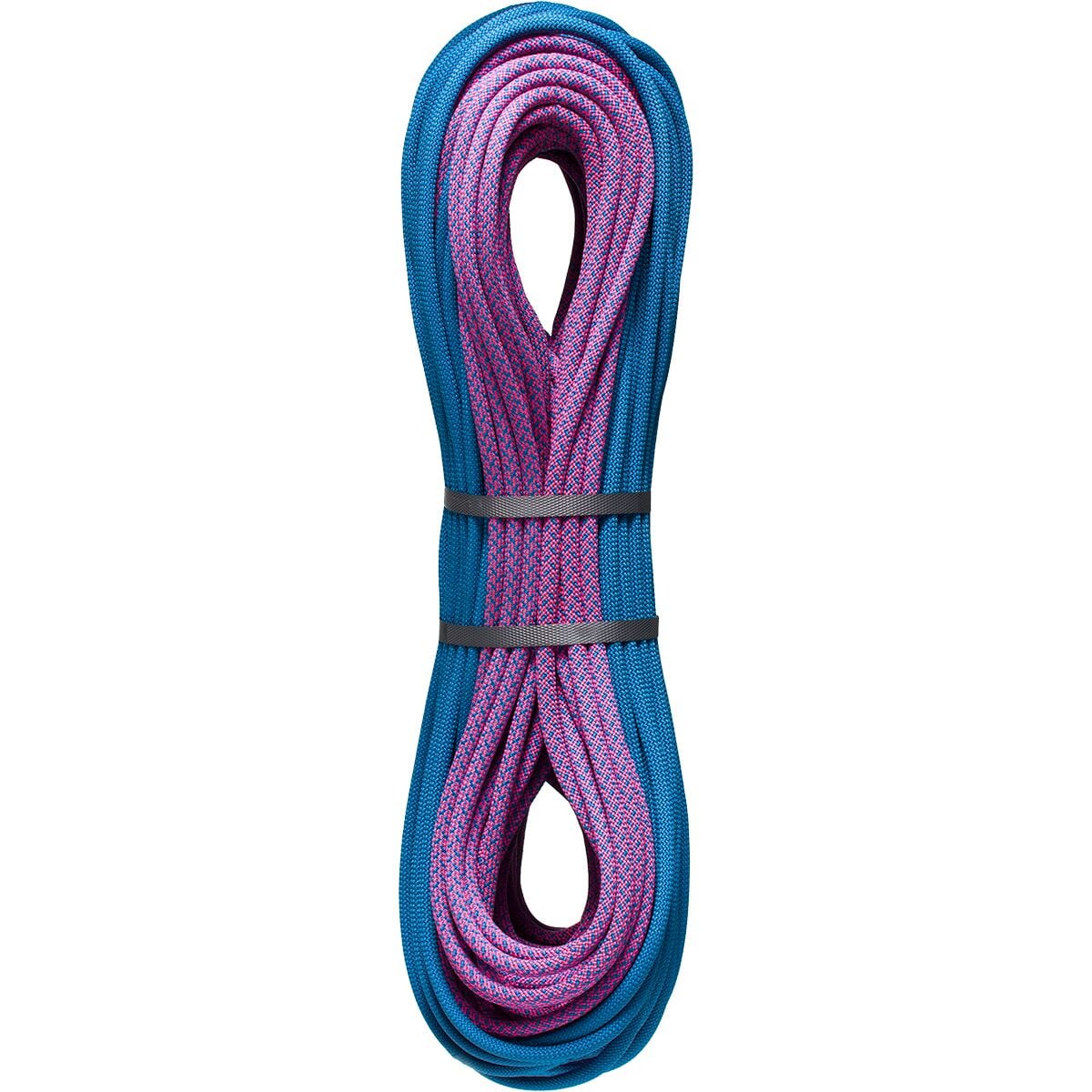
BIPATTERN ROPES
Bipatterning is a modern technique which uses two separate weaves or patterns on each half of the climbing rope. This is an extremely helpful feature for rappelling, as well as understanding how much of the climbing rope is in use at any given moment. The only downside to bipattern ropes is that they are expensive, since the manufacturing process is more complicated. If you can afford it, we will always recommend purchasing the bipattern. They make rappelling and lowering accidents much less likely.
The most extreme example of a bitpattern rope is Edelrid’s Tommy Caldwell ColorTec Climbing Rope, which has two totally different colors on each side of the rope – impossible to confuse. Generally, the change in pattern is a little more subtle — usually one side has a pattern sewn in and the other side is a solid color.
Dry Treatment
Dry treatment is a chemical coating applied to climbing ropes which prevents the rope fibers from absorbing water and dirt. This feature is most applicable for ice climbers, where it is critical for having a good time. Sport climbers and alpine climbers may enjoy dry-treated ropes for slightly improved handling and durability, especially in sandy desert environments. However, we consider this feature as low-importance for beginner climbers.
If it starts seriously raining, most people will pack up and stop rock climbing. If you live in a very rainy place or think you wouldn’t mind climbing in the rain, then a dry treated rope might be useful for you. Keep in mind that dry-treatments will wear off over time, and cannot be re-applied.
If you plan on ice climbing at all, dry-treatment is mandatory.
What Is the Best Climbing Rope? (and what does it cost?)
As we just went over, not all climbers will need all of these features. But if we were to hypothetically add all of the options to our rope, we would end up with:
- A 70 meter single rope
- Slimmer diameter – 8.5-9.3
- Bipattern
- Dry-treated
A few examples of ropes in this category would be:
- Edelrid Tommy Caldwell Eco Dry ColorTec 9.3mm- $350 for 70m
- Beal Opera GoldenDry 8.5mm – $280 for 70m (extra slim, no bipattern)
- Sterling Nano 8.9 Xeros Dry Bipattern – $400 for 70m
Again, beginners probably don’t need such fancy, expensive ropes. But if you wanted to go for the best available, these are the ones you should be looking at.
In Summary
There are a lot of climbing ropes on the market, and any beginner rock climber will have plenty of options to choose from for their first rope. Our recommendation is simply to buy an affordable starter rope in a large, durable size. Climb on that rope until you start to understand your desires for your next rope a little better.
Good luck and stay safe out there!
This article contains affiliate links. Affiliate links help support this blog. There are plenty of other places to buy a rope besides Amazon, including your local gear store, REI, or Backcountry.
 Gym to Crag