Gri-Gri or ATC?
This is the biggest question a beginner rock climber will have to answer as she purchases her starter gear. There are pros and cons on each side, but to give you the Cliff Notes, we believe that a beginner climber is best served by learning to belay on a Petzl Gri-Gri.
Although the ATC is lighter and a little more versatile for outdoor climbing, the Gri-Gri’s assisted locking feature clearly increases safety.
That said, both devices have their place, and an experienced climber will own and know how to use both. Below, we’ll go over some of the basic Gri-Gri or ATC arguments, and explain a bit about how both devices might fit into your climbing goals.
ATC Belay Device
(ATC officially stands for “Air Traffic Control”, but everyone calls it “ATC” or a “tube-style belay device”)
The ATC is the old-timer belay device. It’s solid, simple, and cheap. It works well for belaying top-rope, belaying a leader, and rappelling. The ATC Guide variant works really well for belaying from above on multipitch climbs.
The one downside to an ATC versus a Gri-Gri is that an inattentive belayer using an ATC can easily drop their climber to the ground. If the belayer panics and does not grip the brake strand, the device won’t lock, climber goes splat. To follow: broken legs; ambulance; guilt; disrupted friendships; etc.
The number one rule of belaying is pay attention to your climber, so many feel the ATC teaches good fundamentals, because the stakes are a bit higher than with a Gri-Gri.
Which ATC Should I Buy?

The ATC comes in a few variations: the basic ATC, the ATC-XP, the ATC Guide, and the ATC Alpine Guide.
- Basic ATC: A simple tube, cheap, works for belaying and rappelling. Usually about $20
- ATC-XP: A tube device but with teeth on one side for added friction while lowerting, catching lead falls, and rappelling. $25
- ATC Guide: The most full-featured version of the ATC, this one has an additional circle of metal attached which is used for multipitch climbing and belaying from above. If you eventually want to progress to leading multipitch climbs, it’s not a bad idea to invest in one of these at the start – it’s only a few more dollars and will prevent you needing to buy more kit later. $35
- ATC Alpine Guide: This is a specialized device designed for super skinny double ropes (6.9-9.0 mm). This is an expert tool for more advanced climbers. Make sure not to buy this one as a starter piece – the slots are too skinny to work well with most single ropes. $35
- ATC Pilot: A newer design, and the black sheep of the ATC family, this one looks quite different. Designed to provide some of the assisted-braking functionality of the Gri-Gri, this device is too specialized for us to recommend. $50
Other manufacturers also have their own interpretations of this device – they are all pretty similar.
Gri-Gri
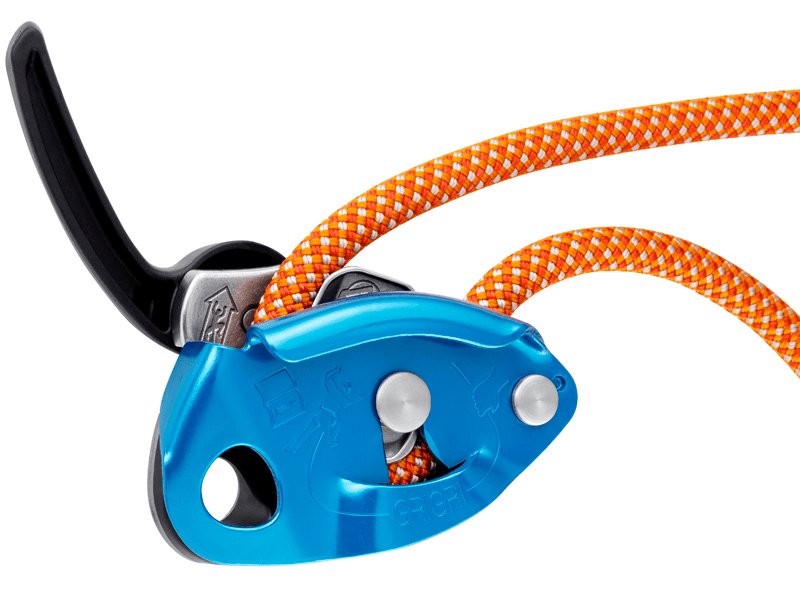
The Gri-Gri, sold by French company Petzl, is the current gold standard for assisted braking belay devices. In simple terms: if your belayer isn’t holding the brake strand, the Gri-Gri *should* still catch you. Many companies have their own take on the assisted braking device, but the Gri-Gri is by a wide margin the most popular. We encourage new climbers to get a Gri-Gri over any competitors device for three reasons:
- The Gri-Gri is time-tested and rock solid
- Your partners are more likely to understand and trust a Gri-Gri
- Most other devices work on the same principle, so once you are familiar with a Gri-Gri, it’s easy to transfer if you decide a competitor’s device has some nuances you like better
The downside to a Gri-Gri is they are heavier and more expensive than an ATC. But particularly if you’re just gym climbing or outdoor sport climbing, weight is never a huge issue and we think the Gri-Gri justifies itself.
Which Gri-Gri Should I Get?
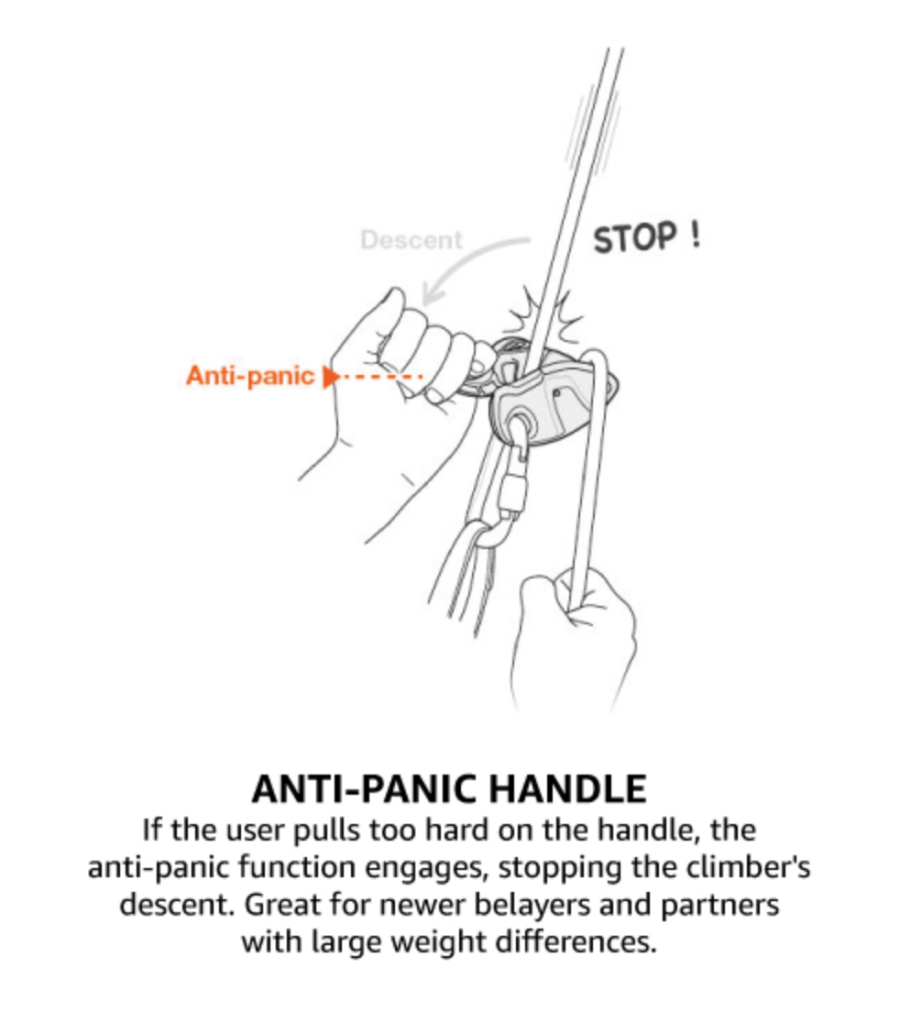
The Gri-Gri comes in two versions, the basic “Gri-Gri”, and the “Gri-Gri+” or “Gri Gri Plus”, which has an anti-panic feature which prevents the climber from being dropped if the belayer cranks open the handle and holds it there.
- Gri-Gri: Aluminum lowering surface will wear out eventually; no anti-panic. List price $100
- Gri-Gri+: Steel lowering plate wears much slower, especially if used in sandstone areas; anti-panic feature useful for climbing with less-experienced belayers. MSRP $130
Some climbers strongly dislike the anti-panic feature of the Gri-Gri+, but it does add additional safety margin, especially with inexperienced belayers who may not know how to properly feather the Gri-Gri handle. The steel lowering plate on the plus is undeniably an advantage – the only reason you’ll ever need to replace a Gri-Gri is when the lowering surface wears out, which will happen on the aluminum versions.
In other words, there is no clear winner between the two Gri-Gri versions. Pick the one which sounds best to you. Both are great devices and will serve you for many years.
Climb on!
 Gym to Crag