One of the more difficult parts of a gym climber transitioning to the outdoors can be finding outdoor rock climbs. In a climbing gym, all the routes are closely spaced, marked with tape, and given an easily-visible consensus grade. None of this is true outdoors. When you want to begin climbing outdoors, you have three options for finding local sport climbs and boulders:
- Ask a friend to show you
- Use MountainProject.com (Or your country’s equivalent website)
- Buy a climbing guidebook for your target area.
In this post we’ll evaluate the pros and cons of each option.
Mountain Project
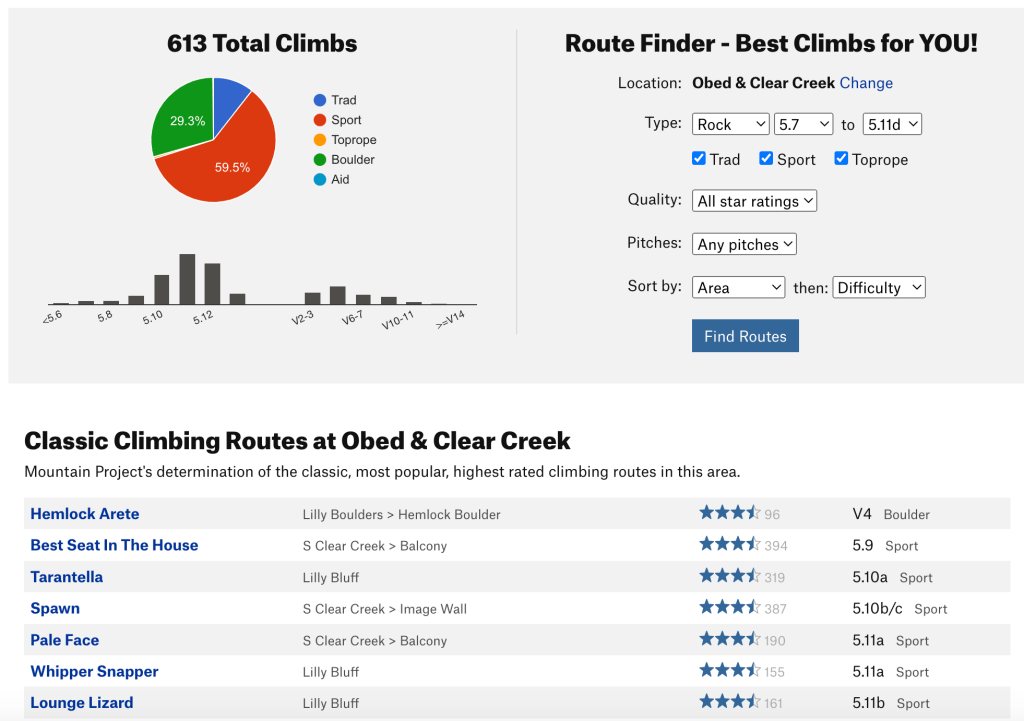
Mountain Project is the biggest climbing website in the USA, with some limited coverage of foreign climbing destinations. The main MP website functions as a semi-open wiki, with climbers encouraged to submit area and route information, descriptions and photos. Submissions are moderated by regional admins, and some areas are purposefully kept off Mountain Project. Users can comment on specific routes or areas to share beta, and the website also has an active forum section.
Most people will want to use the Mountain Project route database, accessible online or via the Mountain Project App (iOS, Android). The route database can be used for both exploring and locating crags (via interactive GPS maps), and locating routes at the crag.
Other countries have similar websites, such as UKClimbing or thecrag.com.
Mountain Project Pros
- Free 🙂
- Mobile App
- Fairly comprehensive and up-to-date for popular, modern crags
- Users can submit updates and photos to fill in gaps
- Constantly evolving, dynamic database
Mountain Project Cons
- Need to download whole states/countries to access those routes offline
- Need to download photos in advance to access offline (easy to forget)
- Route locations can be difficult to understand (often route x is 3 feet left of route y, which is 10 feet left of route z, etc.)
- MP is owned by OnX, and may go to a subscription model in the future.
- Phones can run out of battery
Climbing Guidebooks

Guidebooks are a genre of their own. If you have yet to pick one up in your climbing career, we can recommend it wholeheartedly. The quality varies from book to book, but the basic idea is that a climbing guidebook should contain all the information and known routes in a particular area – e.g. all routes in Little Cottonwood Canyon, or the Grand Teton Range. They are especially useful for sport climbing crags with a high density of routes, or for older, more obscure areas where knowledgeable locals might be hard to find and online beta is scarce or nonexistent.
Where to Buy Guidebooks?
The best bet is usually your local specialty climbing shop, something like Neptune Mountaineering (Boulder), Nomad Ventures (Southern California), Rock and Snow (New Paltz). If you live in an area without a specialty climbing shop, your local REI may have a small selection of local guides.
Buying climbing guidebooks online is also an option, of course. You have a few options, although the availability of the book and the competency of the publisher do play a role. Let’s look at the High on Moab book for example. You could:
Climbing guidebooks are generally a little harder to buy online than most things – especially older guides, which often go out of print fairly quickly (2-5 years after publication). If you can’t find a new copy of a particular book, you may consider searching for used copies.
Climbing Guidebook Pros
- A book never runs out of battery
- Generally higher quality informational photos
- Buying a copy helps support the author – authors are often local developers
- No need for cell service
- Your friends will like you
- Maps, indices, make finding routes pretty easy
Climbing Guidebook Cons
- Not free 😦
- Sometimes not as up-to-date as online info
- Additional thing you need to carry
- People at the crag will always be asking to borrow your book
- Take up space
Local Friend
An informed friend is also a great option for making the transition to climbing outside. Ideally this person has at least a little more climbing experience than you, is safety minded, and can operate as a mentor in your climbing journey going forward. That’s not always the case, so please use your nose. When one inexperienced climber starts taking other inexperienced climbers outside, things can get a little sketchy.
Friend Pros
- You have a friend, yay!! Congratulations.
- Free
- They may know the better spots, the bust places, sun angles, etc.
- You have a ready-made belayer/rope gun
- Friend may know about secret areas not on MP or in guidebooks
Friend Cons
- If you are a beginner climber, you may not be able to properly evaluate your partner’s safety habits
- You are relying entirely on this other person’s knowledge to be correct and accurate. Often, it isn’t.
- They could be annoying
Overall, all three options present a good way to get outside and do some climbing on real rock. Most serious climbers will use a mix of all three resources. While Mountain Project or other online databases can be useful for a day or two if you’re visiting an area, we prefer guidebooks in most situations where you hope to be climbing in the area frequently.
 Gym to Crag